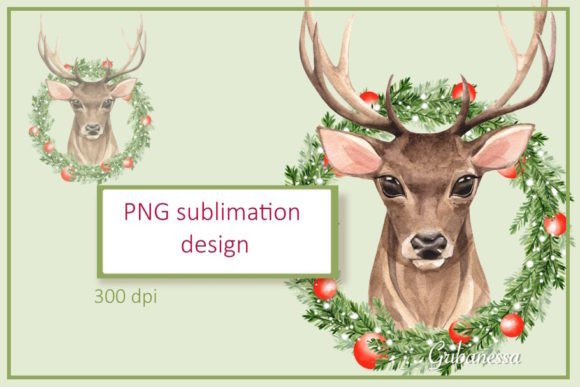
Reviewing the Watercolor Deer Christmas PNG for Embroidery
As a designer who has spent years translating digital art into thread, I approach every new asset with a mix of excitement and skepticism. We have all been there: you find a stunning graphic online, envision it perfectly stitched on a holiday sweatshirt, and then realize halfway through the digitizing process that the details are too fine or the color transitions are impossible to replicate with thread. This is why I took a close, practical look at the Watercolor Deer Christmas PNG. While this file is categorized under Illustrations and is technically a raster image, its value to an embroidery professional lies in how well it serves as a reference for creating a high-quality machine embroidery design.
First Impressions: Mood and Visual Personality
The immediate appeal of the Watercolor Deer Christmas PNG is its softness. Unlike vector clipart that can feel rigid and cold, this image carries the organic, bleeding edges characteristic of true watercolor painting. The deer motif is gentle, evoking a sense of calm winter nostalgia rather than loud, commercial holiday cheer. For an embroidery project, this mood is invaluable. It suggests a product that is meant to be cherished, not just worn.
From a layout perspective, the composition is balanced. The deer is central, likely surrounded by subtle hints of winter foliage or snowflakes, which provides a natural frame. However, as an experienced reviewer, I look past the pretty picture to the structural reality. Watercolor effects rely on gradients and transparency. In embroidery, we do not have transparency; we have thread overlap and density. This means the Watercolor Deer Christmas PNG is not a "plug-and-play" embroidery file but rather a sophisticated blueprint. It requires a skilled digitizer to interpret those soft washes into fill stitch patterns that mimic the artistic intent without creating a stiff, cardboard-like patch on the fabric.
Real-World Application: The Holiday Sweatshirt Test
To truly evaluate this asset, I imagined a real-life scenario: a custom order for a boutique client wanting a line of premium holiday apparel. The goal was a unisex crewneck sweatshirt that felt cozy and artisanal. Using the Watercolor Deer Christmas PNG as the visual guide, I considered how the design would translate to cotton fleece.
Sweatshirts are forgiving due to their thickness, but they also absorb thread, making dense areas heavy. If I were digitizing this design based on the PNG, I would lean heavily into running stitch outlines for the finer antler details to keep them delicate. For the body of the deer, a lighter density fill stitch would be essential to maintain the "watercolor" feel. A solid, dense fill would kill the artistic vibe. The result, if executed correctly, would be a sweatshirt embroidery piece that looks painted on, offering a high perceived value that justifies a higher price point for the craft business owner.
This design also shines in home decor. Imagine it stitched onto a natural linen tote bag design or a raw-edge canvas pillow cover. The rustic nature of the deer complements natural fibers beautifully. For an Etsy seller, this versatility is key. You are not just selling a deer; you are selling a cohesive aesthetic that fits into modern farmhouse or minimalist holiday decor trends.
Navigating Technical Challenges and Fabric Choices
While the aesthetic is strong, the Watercolor Deer Christmas PNG presents specific challenges that must be addressed before hitting the start button on your machine. The primary concern is detail loss. Watercolor art often features very subtle shifts in tone. In embroidery, if these shifts are too small, they become indistinguishable blobs of thread.
I would advise extreme caution when using this design on stretchy fabric like jersey knits for baby clothes. Without proper stabilization, the fabric will pull away from the stitches, distorting the delicate lines of the deer’s face. For baby embroidery, I would recommend scaling up the design slightly to ensure the stitch density is not so high that it compromises the softness of the garment. A heavy, dense design on a onesie is uncomfortable for the wearer and looks amateurish.
Similarly, consider the hoop size. If you are attempting to place this on a curved surface like a cap, the large flat area of the deer’s body might pucker. Caps require specialized digitizing techniques, often breaking the design into smaller sections or using a different backing material. For a beginner, sticking to flat surfaces like aprons, tea towels, or tote bags is the safer bet to ensure the finished product looks professional.
Color contrast is another critical factor. The watercolor style likely uses muted tones. If you stitch this on a dark navy or black fabric, the details may vanish. Always test your thread colors against the fabric background. You might need to add a white or light-colored underlay or border to make the design pop, effectively turning it into an applique design hybrid if the contrast is insufficient.
Enhancing Brand Value and Customer Trust
Why go through the trouble of carefully interpreting a PNG instead of buying a pre-digitized file? The answer lies in brand consistency and uniqueness. Many small shop product listings suffer from using the same generic designs as everyone else. By using the Watercolor Deer Christmas PNG as a base for a custom digitized job, you create a unique handmade product that stands out.
Customers can tell the difference between a cheap, overly dense embroidery and a thoughtful, airy design that respects the fabric. When a customer receives a personalized gift featuring this deer, the soft, artistic quality conveys care and professionalism. It builds trust. They are more likely to return for future holiday embroidery needs or recommend your commercial embroidery services to friends because the product feels premium.
Furthermore, this image serves as an excellent tool for marketing. Before you even stitch a single thread, you can use the PNG to create high-quality printable mockup images for your online store. This allows you to gauge customer interest and refine your product offerings without wasting materials. It is a versatile design asset that works hard for your business both in the digital storefront and in the physical production phase.
Practical Notes for the Embroidery Designer
If you decide to incorporate this design into your workflow, here are my final practical recommendations:
- Test on Scrap First: Never run a new interpretation of a watercolor design directly on the final garment. Use scrap fabric of the same type to check tension and density.
- Check Stabilizer Compatibility: Watercolor effects require smooth stitching. Use a cut-away stabilizer for knits and tear-away for wovens to prevent distortion.
- Verify Licensing: Since this is a PNG under Illustrations, confirm the license terms. Ensure you have the right to use it for commercial embroidery projects if you plan to sell the finished items.
- Digitize for Clarity: Do not try to replicate every pixel. Simplify the color palette to 3-5 thread colors to maintain stitching clarity and reduce production time.
- Consider Thread Sheen: Use matte threads like cotton or rayon rather than high-sheen polyester to better mimic the flat, organic look of watercolor paint.
In conclusion, the Watercolor Deer Christmas PNG is a promising starting point for serious makers. It is not just a picture; it is an invitation to create something beautiful. With careful digitizing and attention to fabric choice, it can elevate your embroidery project from standard to exceptional. Whether you are creating a custom apparel line or a one-of-a-kind embroidered patch, this design offers the artistic depth needed to captivate your audience.